— Research and Ideas
Fresh thinking (and some familiar tools)
— Home
Where knowledge brokerage meets statecraft
— Advisory
From knowledge input to solution design
— Impact Study & the AI Studio
Knowledge brokerage meets statecraft and AI
— Impact Fellowship
A different kind of civil service
The theory and evidence behind the framework, plus how we work with academics to develop their research to have real-world impact.
⌄
Research and Ideas
The Impact Framework
Back to top ↑
Why Curio works differently
The Structural Problem
Government fails not from want of will, but want of architecture.
SPD
Strategy-Policy-Delivery: the traditional modes of government activity separate knowing from doing by design. They are linear, slow and incapable of working effectively across organisational boundaries.
VTF
The UK Vaccine Taskforce convened the right experts and expertise to work adaptively on solution design. Their success meant the UK was the first country to approve and deploy both mRNA and adenoviral vaccines. Beyond their crisis privilege, there are key lessons here for the way governments can work.
Curio
The Impact Framework codifies what the VTF proved: that integrating expertise, action and feedback in a single recursive system produces radically better outcomes.
Our Answer
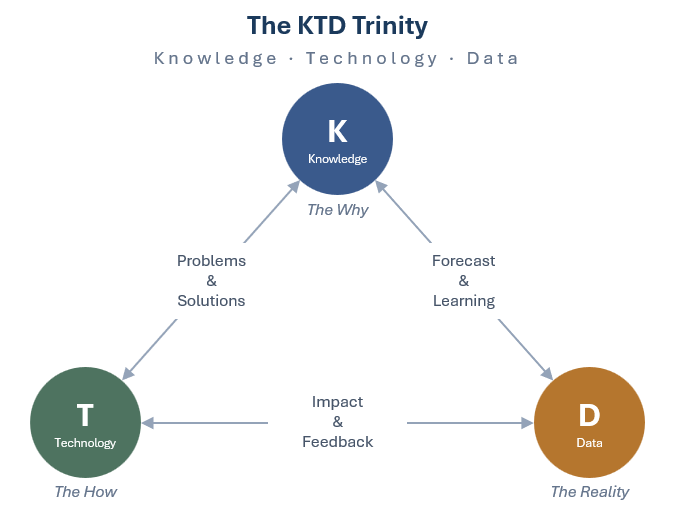
Knowledge, Technology and Data — held in play together.
K
Knowledge — Understanding and Belief
Political direction, deep expertise, tacit insight and lived experience. Sustainability as a first-order design principle from day one.
T
Technology — Where mission meets citizen
Contracts, legislation, digital systems, care pathways — not downstream implementation, but the site of action from the outset.
D
Data — what the real world tells us
Real-time intelligence that flows both ways: accountability and redesign. Not a reporting mechanism — a learning system.
Research Collaboration
Back to top ↑
Working with Academics on Impact
On academic research partnerships, the know-do gap, and the tests and tools we use to help research findings reach decision-makers in time.
Read more ▾
Academic research often struggles with the pace demanded by government — and the know-do gap is a notorious highlight of this challenge. Multi-year research collaborations may find that the context they are studying moves on before their findings are ready: Key governance decisions are made while the study takes place.
Curio can work in collaboration with academic projects to develop academically robust ways to deploy appropriate research findings to decision-makers before those windows close.
We can also help research projects track and manage their likelihood of impact, to ensure their findings are ultimately used most effectively to make a difference in the real world.
Curio can work in collaboration with academic projects to develop academically robust ways to deploy appropriate research findings to decision-makers before those windows close.
We can also help research projects track and manage their likelihood of impact, to ensure their findings are ultimately used most effectively to make a difference in the real world.
The Know-Do Gap
"There is often a disconnect between what we know and what we do in healthcare."
It takes, on average, 17 years for an evidence-based healthcare intervention to reach routine practice — and many never do.
With thanks to the Centre for Evidence and Implementation (CEI) for this framing.
Where This Comes From
Back to top ↑
The Impact Practice research
The scholarship and experience behind the Impact Framework — the problem with conventional government, the Vaccine Taskforce as proof of concept, the KTD Trinity, and a note on belief.
Read more ▾
Curio's impact approach brings together effective knowledge brokerage with high-quality statecraft.
The model emerges from our experience working in government and government consulting. It is also grounded in research into what we can learn from successful solution design in government, particularly Covid-19 and other government digital projects (see examples below).
The Impact Framework (Knowledge, Technology, Data) and the Sustainable Impact Practice it supports are the working synthesis of that experience and scholarship (so far), tested with civil service teams and revised through continuous practical reflection, feedback and learning.
The Problem With Conventional Government
Conventional governments operate through strict hierarchies of accountability. There are many models for this, such as the tripartite disciplines of Strategy, Policy and Delivery.
Strategy
Set direction from the top. The wider knowledge base tends to be held remotely and advice or input is heavily filtered.
Policy
Translates strategy into statements of intent, such as white papers, legislation, contracts, pathways and other instructions to the system.
Delivery
Executes the policy instructions — generating a lot of tacit knowledge and data that is often lost, but could be a powerful driver of effective adaptive design.
Most of these models tend to assume a settled destination that is hard-coded into intent very early on: Strategy sets direction, Policy translates it into intent, Delivery turns that into action. The hierarchies can work well when stability and hierarchical accountability are fundamental to success. But sometimes these qualities conflict with the actual goals. Wicked problems resist solution by decree and digital solutions need to be able to adapt, rather than settle into a stable state (stable state vs steady state are two different things).
The problem runs deep: epistemological hierarchy tends to privilege abstract, centrally produced knowledge over situated, technical and tacit knowledge. The system is designed to filter information to make it manageable: important learning from the lived experience of citizens, academic insights, innovation from the center to the edge and tacit expertise, which can only be generated at the point of delivery, are all filtered through remote and artificial reporting structures that risk rendering their lessons meaningless — in effect, they are routinely excluded from solution design.
The UK Vaccine Taskforce: designing solutions instead of intentions
When COVID-19 arrived, government did not know what it was working towards — a vaccine, herd immunity, suppression — and without a strategic consensus, the normal SPD engine had nothing to drive. Instead, the UK Vaccine Taskforce was built around the problem: knowledge, technology and data held in play simultaneously rather than handed off in sequence, so that science informed procurement, procurement generated manufacturing data, and that data reshaped the portfolio in real time. Other countries also used this approach — or approaches like it — to achieve their own success.
The VTF As Proof Of Concept ▾
The UK's first COVID-19 response was hierarchical and not structured to make the best use of available expertise and advice. Module 2 of the COVID-19 Inquiry examined the UK government and the three devolved administrations, and Baroness Hallett concluded their pandemic response was a repeated case of "too little, too late." The VTF worked differently: it bypassed those decision-making structures and integrated deep external knowledge, technology held in play from the outset, and real-time data simultaneously — leading to the UK becoming the first country to approve and deploy both the Pfizer-BioNTech and Oxford-AstraZeneca vaccines.
How The Impact Framework Answers This
The Curio Impact Framework generalises what the VTF got right into a framework and set of practices designed to operate effectively across the boundaries and hierarchies of government.
The distinction it draws is between policy process and solution design: a policy process generates, through hierarchy, a statement of intent — legislation, regulation, guidance — with technology arriving at the end to implement what is already decided. Solution Design makes technology the site of action from the outset: not "what does the policy say?" but "what do we need to build?".
The distinction it draws is between policy process and solution design: a policy process generates, through hierarchy, a statement of intent — legislation, regulation, guidance — with technology arriving at the end to implement what is already decided. Solution Design makes technology the site of action from the outset: not "what does the policy say?" but "what do we need to build?".
The intent here is not to abandon the conventional hierarchies, which remain essential for accountability. Instead, the Impact Practice brings effective knowledge brokerage together with expertise in conventional statecraft to work effectively across the system.
Knowledge combines understanding — analytical, evidence-based, expert — with belief: the convictions that determine what a system treats as its mission.
Technology is the site of action — what is actually designed: the platform, pathway or protocol where mission meets citizen.
Data is the adaptive feedback mechanism, genuinely two-way, carrying what frontline workers observe back to the people who can act on it. Held in a continuous loop rather than a one-way handover, each corrects the others as it runs.
A Note On "Belief" ▾
Belief: the democratic mandate, political conviction, the received wisdom of profession, a community's own sense of what's at stake… too often, these things are treated as noisy externalities to good policy design — seen as gaps to be closed with "more evidence."
Vaccine hesitancy is a powerful case. For a lot of people, vaccine resistance wasn't ignorance of the science; it was a different, internally coherent, response, where the relationship between the state, the pharmaceutical industry and self-determination was the primary frame of reference, rather than the epidemiological calculus that structured the expert view.
Belief also gives public action its legitimacy, so it is not a variable to engineer away. Governance systems that ignore the structured, collective and democratically embedded nature of belief do not escape it. Instead, they end up delivering the beliefs of those closest to the centre, while systematically failing to register the signals that would tell them what is actually happening in the worlds they govern.
Whether it is direction from the ballot box or tacit knowledge from the front line, Curio understands that belief is an important component of Knowledge. Our Consistency Test is designed to surface the gap between understanding and belief, so that the Impact Practice can hold both in productive tension.
This is the "small p" political consensus that makes it possible to achieve impact in the real world.
Vaccine hesitancy is a powerful case. For a lot of people, vaccine resistance wasn't ignorance of the science; it was a different, internally coherent, response, where the relationship between the state, the pharmaceutical industry and self-determination was the primary frame of reference, rather than the epidemiological calculus that structured the expert view.
Belief also gives public action its legitimacy, so it is not a variable to engineer away. Governance systems that ignore the structured, collective and democratically embedded nature of belief do not escape it. Instead, they end up delivering the beliefs of those closest to the centre, while systematically failing to register the signals that would tell them what is actually happening in the worlds they govern.
Whether it is direction from the ballot box or tacit knowledge from the front line, Curio understands that belief is an important component of Knowledge. Our Consistency Test is designed to surface the gap between understanding and belief, so that the Impact Practice can hold both in productive tension.
This is the "small p" political consensus that makes it possible to achieve impact in the real world.
Impact and AI: A Model For The Future
Back to top ↑
Our Impact Framework offers a practical way for teams to establish the foundations of an Agentic AI future.
Curio works with augmented AI in its daily routines, and the Impact Practice is already using the organisational grammar of Agentic AI: our underlying discipline brings modular networks to design technology solutions that adapt in response to real world data.
Curio works with augmented AI in its daily routines, and the Impact Practice is already using the organisational grammar of Agentic AI: our underlying discipline brings modular networks to design technology solutions that adapt in response to real world data.
Curated Links
Back to top ↑
Essential reading on governance, evidence and impact
Three-star resources for practitioners, grouped under Policy & Governance, Implementation & Evidence, and Digital Government.
Read more ▾
Three-star resources for practitioners working on governance reform, implementation and the Digital State.
Annotated Bibliography
Back to top ↑
The epistemologies we govern by
Compiled by Jake Love Soper in support of doctoral research at UCL. Organised around the intellectual architecture of the Impact Framework argument — from NPM's foundational assumptions through the STS tradition, to mission-driven government and the decolonial critique.
Read the annotated list ▾
Impact Framework Worked Examples
Back to top ↑
Other inspirations for the Impact Framework
Aadhaar, the Philippines' 4Ps cash-transfer programme, and SwipeRx, each read through Knowledge, Technology and Data.
Read more ▾
These are not Curio projects — they're examples we've learned from to build the Impact Framework, reinterpreting well-known ventures through its lens to understand why they worked.
Aadhaar / India Stack
Universal digital identity
K Community trust & local agent knowledge of enrolment barriers.
T Identity as a platform layer for finance, health, education.
D Real-time uptake data feeding back to agent networks.
Outcomes varied by design quality, not political mandate — the architecture generates investible value.
4Ps / Pantawid
Conditional cash transfers, Philippines
K Health workers' knowledge of why families miss conditions.
T Digital payments with adaptive conditionality.
D Real-time exception data feeding redesign.
Our Impact Framework produces an adaptive social protection system that learns — visible to development investors.
SwipeRx
Digital pharmaceutical network, SE Asia
K 120,000 pharmacists' dispensing & supply-chain knowledge.
T A platform designed with the network as intelligence nodes.
D Dispensing & supply data flowing back into design.
The network is an intelligence layer the platform is built around, not a delivery channel.